Big Bad Wolf
Her First Werewolf (BBW, Werewolf, Prince Charming, Fairy Tale Romance)The Big Bad Wolf is the central fairy-tale figure reworked through Charles, the man Flora encounters in the forest. Rather than remaining a simple predator, the figure moves through several identities—pursuing wolf, ravenous lover, protective beast, and potential husband—so that danger and desire become inseparable from the story’s transformation of the Little Red Riding Hood motif.
Introduction and Fairy-Tale Function
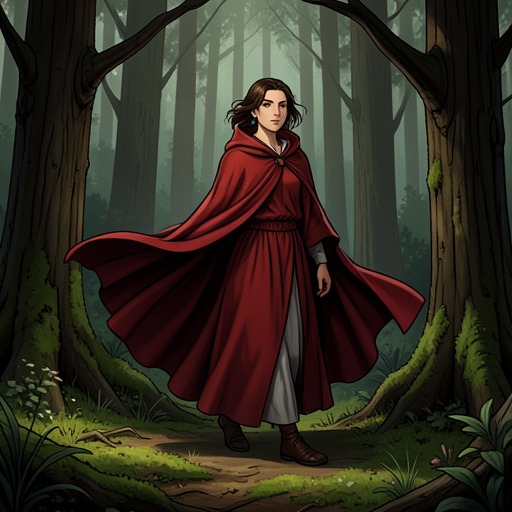
The story explicitly frames Flora’s journey through the familiar image of the wolf in the woods. She is known as Red because of Flora’s red velvet cloak, is sent by her mother toward her grandmother’s house beyond the forest, and carries a basket of food; the promotional description identifies this route as an encounter with “the big bad wolf.” The framework is recognizable, but the expected moral warning is redirected toward adult sexuality and romantic fantasy rather than ending in the wolf’s defeat.
The figure is foreshadowed even before Charles appears openly. When Hans argues that young women want someone to pursue them “as a wolf chases after a lamb,” Flora answers by recalling the wolf’s violence: the wolf may eat the lamb. That exchange establishes the Big Bad Wolf as both a metaphor for courtship and a real image of predation. Flora’s father, meanwhile, had taught her to read body language, gestures, and the movements birds use to attract mates. The text therefore connects the wolf’s pursuit to a broader language of animal display, bodily signals, and communication beyond words.
Charles as the Wolf in the Woods
Charles initially appears as a handsome, masculine traveler whose manner intrigues Flora. The story’s description presents their first meeting as an immediate attraction, emphasizing his physical appeal and the force of his presence. During their sexual encounter, however, his human appearance begins to fracture. His voice becomes a growl, his eyes glow, and his teeth lengthen and sharpen; Flora recognizes that the man beside her sounds like a wolf, though she remains absorbed in the experience and does not yet fully understand what he is.
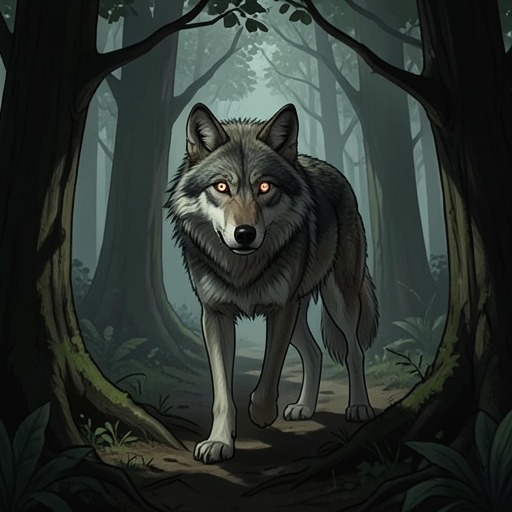
The transformation is made unmistakable when a large, black, fanged snake threatens Flora. Charles tells her not to move, takes up a stick, and changes before her eyes from a man into a huge black wolf. The beast kills the twenty-foot snake in a single bite. This is the Big Bad Wolf’s decisive reversal: the creature associated with danger becomes the force that removes an immediate danger. His emerald gaze remains recognizably Charles’s, and Flora understands that the wolf is not a separate intruder but another form of the man she knows.
Charles then reveals his identity through a voice inside Flora’s head, admitting that he is a werewolf and expressing shame about it. The confession gives the monstrous form an inward dimension. The wolf is not merely a disguise or an external threat; it is an identity Charles has always carried and regards as an affliction. His telepathic speech also confirms that the animal form has its own means of intimacy and communication, even when the human mouth is absent.
Desire, Predation, and Protection
The Big Bad Wolf is linked to sexual hunger as strongly as to physical strength. Before the transformation is explained, Charles speaks with ravenous urgency, and his behavior is described through animal imagery: growling, glowing eyes, and the sense that Flora is being approached as vulnerable prey. The scene deliberately recalls the lamb-and-wolf metaphor from Flora’s earlier conversation with Hans, but it complicates that metaphor by giving Flora desire as well as fear. The wolf’s pursuit is threatening, yet the narrative presents the encounter as mutually wanted at crucial moments.
The wolf’s animal body also functions as an instrument of rescue. Charles’s strength allows him to hold Flora effortlessly, and his transformed body destroys the snake that might have killed her. Once the immediate danger has passed, he does not attack her. He lowers his head, whimpers, curls beside her, and nuzzles her thigh. Flora calls him a beautiful wolf and pats his fur, while he asks whether she is afraid. She answers that she is not, because his movements show that he does not intend to hurt her. In this exchange, the “bad” wolf is reclassified through behavior: his power remains visible, but it is interpreted as controlled and protective.
The contrast between the threatening title and the affectionate encounter produces the story’s central paradox. Charles is powerful enough to embody the predator of the fairy tale, yet he is also vulnerable enough to feel shame, seek reassurance, and promise care. The narrative does not erase the danger suggested by his appetite and transformation; instead, it converts that danger into the basis of an erotic and romantic fantasy in which the monstrous figure is made safe through attachment.
Relationship with Flora
Charles’s relationship with Flora develops from pursuit into recognition. He tells her that he has been tracking her for days at her farm and wants to take her away from her current life. The detail makes his interest precede their formal intimacy: he has observed her before she understands that he is present. This recalls the wolf’s hidden movement through the forest and gives his courtship an element of surveillance, but Flora interprets the attention as a form of being watched over rather than solely as a threat.
After revealing himself, Charles says that he is falling for Flora. She responds by pointing out the possible consequence of their sexual encounter—she may be pregnant—and Charles promises to take care of her if she wants him. Flora accepts despite knowing him only briefly, describing the bond as a feeling that they have known each other all their lives. Charles then returns to human form, the form in which Flora gave him her maidenhood, and expresses his attraction to her scent. His movement between animal and human states thus accompanies a movement between bodily instinct and declared emotional commitment.
The relationship also answers Flora’s resistance to the social expectations surrounding marriage. Flora has feared that marriage would cost her freedom, reading, and ability to think for herself. Her mother sends her toward her wealthy grandmother in hopes of obtaining money for a dress and improving Flora’s marital prospects, while Flora distrusts the idea of asking for financial help and dreads a marriage to a man she does not love. Charles’s pursuit first resembles the coercive marriage market she rejects, but his later promise of care and his own unconventional identity turn the encounter into an alternative romantic arrangement.
From Black Sheep to Proposed Husband
Charles reveals that he has royal status, although he is not first in line to inherit. Six older brothers and their families stand between him and the throne, making his succession extremely unlikely. He describes himself as a black sheep, and Flora answers that he might more accurately be called a “black wolf.” The pun transforms social marginality into a shared emblem: Charles is excluded from conventional inheritance and marked by his werewolf identity, but those same conditions give him unusual freedom.
That freedom directly enables the proposal. Charles explains that his father has allowed him to choose whom he will marry because of his affliction. The Big Bad Wolf therefore becomes not only a supernatural lover but a figure through whom the story resolves the conflict between desire and marriage. Flora has opposed being assigned to a wealthy man by her mother; Charles offers a marriage based on his own choice and presents himself as someone able to choose her. The proposal comes suddenly, but it converts the forest encounter from an isolated transgression into the prospect of a socially recognized future.
Narrative Significance
The Big Bad Wolf gathers together the story’s recurring oppositions: human and animal, threat and protection, shame and attraction, social conformity and personal freedom, and fairy-tale danger and adult romantic fulfillment. The wolf chase first appears as Hans’s metaphor for female desire, then becomes a literalized presence in Charles, whose body makes the metaphor visible. Flora’s red cloak, the forest path, the destination of her grandmother’s house, and the wolf’s appearance preserve the Little Red Riding Hood structure while changing its outcome.
The figure’s most important transformation is ethical and narrative rather than merely physical. Charles’s black wolf form initially confirms Flora’s fear that the wolf may consume the lamb, but the same form saves her from the snake and behaves with tenderness afterward. His confession of lifelong shame invites sympathy, while Flora’s refusal to fear him allows the monster to become a partner. By the end, the Big Bad Wolf is no longer simply the story’s danger in the woods; he is the means by which Flora’s wish for love without surrendering her freedom is imagined as possible.